Q&A: Mavis MacNeil

Composer Mavis MacNeil discusses “La Dame,” featured on Sputter Box’s debut album.

Mavis MacNeil. Photo: Colleen Miller.

Sputter Box’s debut album, Sputter (SHRINKS THE) Box, features more than 25 brand new miniatures, each scored for bass clarinet, voice, and djembe.

La Dame” is Track 04 on the album.

A second miniature by the composer, entitled “Trapped,” is Track 14.

NATASHA NELSON: I enjoyed reading the program note in the preface to the score for โ€œLa Dameโ€! Would you begin by sharing a few details about the miniature for readers?

MAVIS MACNEIL: Sure! Itโ€™s funnyโ€”I always write a program note to put in my score, but I feel like I always have to pick [just] one little slice of what a piece is about. I had a lot of fun writing โ€œLa Dameโ€ because I really love these three instruments, specifically. I would say percussion, bass clarinet, and voice are some of my favorite instruments to write for. I think if I were asked to name my three favorites, they might be those, plus cello. So that was really exciting.

I really loved getting to write a sort of microcosm of a piece. That was a cool thing, to try to write with a time constraint, because so often I feel like Iโ€™m aiming for a longer duration.

Did the goal of composing this piece specifically to be recorded influence how you approached the writing?

MM: Yes, definitely. As I was thinking about the piece, there were things that I wanted to write that I realized wouldnโ€™t be ideal for the approach Sputter Box was taking for this particular project, for recording separately. I tend to like to add contrapuntal and hocketing elements [in my scores], and the ensemble asked us to avoid the latter for this project. I really liked that challenge because I think itโ€™s so easy for me to try to put [numerous] ideas into a composition and make things complex. This really forced me to focus on simplifying.

I was excited to see that “La Dame” (“The Woman”) features a text by Guillaume Apollinaire! Iโ€™m familiar with some of Poulencโ€™s settings of his poetry and I have a book of Apollinaire texts and translations stored away somewhere.

MM: Oh wow, cool!

Have you written for voice previously?

MM: Iโ€™ve written for the voice quite a lot. Iโ€™m a singer.

Me too! In which languages do you usually write vocal music?

MM: This mightโ€™ve been my first foreign language text, actually. I think Iโ€™ve primarily set text in English.

What was it like setting text in another language?

MM: It was fun, definitely. This spring, I joined C4 Ensemble (the Choral Composer/Conductor Collective), which is a collective in New York. Itโ€™s a really good choir. Most of the members are also composers or conductors and theyโ€™re serious singers. In hearing people talk all the time about how they think about text when theyโ€™re setting it โ€“ in terms of vowels, and especially French vowels as applicable here, passaggio, and very specific things that, as a singer, you think I would automatically be thinking of โ€“ I was more conscious of it. I was glad to have that in mind as I was approaching it.

Did you have Apollinaireโ€™s poem in mind for this project from the start?

MM: I have a lot of books of poetry, and I usually start with text when Iโ€™m composing. My first thought was Mina Loy, a Modernist poet. She was a really interesting person. I remembered her having some really vivid imagery in short passages from longer poems. I was looking through a book of her texts โ€“ her poetry โ€“ but nothing really felt quite right. Then I noticed the Apollinaire book on my shelf.

I was reading through a bunch of poetry and I came across โ€œLa Dame.โ€ It was the right length, I thought. It ended up being a little long for a minute-long piece, but I thought it was really cool. As I say in my program note, itโ€™s dark, but it also has this silliness to it, because it depicts a little mouse running around, watching a corpse being carried out of this building.

I see! So would you say it conveys a level of absurdity thatโ€™s heightened, to the point where one could see it through an almost-comical lens?

MM: Thatโ€™s what I thought. What happened, though, was after deciding that was the text I was going to set, I wrote it down in my manuscript-paper notebook. Then, the following week โ€“ this was in March โ€“ my partner and I decided we were going to leave New York and come to Vermont, which is where Iโ€™m from. After much deliberation, we decided that was the right choice. I brought my notebook, but I didnโ€™t bring the book of poetry. I was kind of glad I [ultimately] didnโ€™t have [the published translation] in front of me, because I think the English translation is under copyright, and I didnโ€™t want to be influenced by it. Itโ€™s such a short poemโ€”itโ€™s pretty easy to do a literal translation of it, but I didnโ€™t want to be looking at the other one.

Pictured: An excerpt of the vocal part from MacNeil’s full score for “La Dame.”

Whatโ€™s your vocal fach?

MM: Iโ€™m a soprano. Iโ€™ve written some songs that Iโ€™ve performed myself. I started writing the piece by going through the text and thinking about how I wanted to set that. The vocal melody came first. Alina has such beautiful, shimmering high notes. Sheโ€™s amazingโ€”it was so cool to get to write for her.

Absolutely! I see this cool indication in the score for the vocal part. It says: “Act startled by other parts (maybe jump a little).” Would you consider this marking theatrical in nature?

MM: Yeah! I was thinking about it being theatrical since I knew it would be a video performance. I think I had seen a few posted before I sent my score in to Sputter Box, so I knew they were using these tight camera shots [for their recordings] and that a facial expression would be really visible. I donโ€™t tend to put theatrical indications in my scores, but it just seemed like a fun little thing to include.

How about extended techniques? I see there are a couple indications for bass clarinet, such as key clicks, and for djembe.

MM: Yeah! Because of the medium, I didnโ€™t want to do anything too crazy, and the ensemble actually gave guidelines about that, so I was trying to keep it simple in that regard. I like having some different timbral things and sounds that are [somewhat] extended.

I heard this Meredith Monk interview once where she talked about when writing a piece, not letting the extended techniques be your priority or dictate how youโ€™re writing it. I think some people do that really well and it can be fun to emphasize this one extended technique in a score. But personally, it resonated with me just to think of [extended techniques] as a bit of color to use once in a while. And that tends to be my approach.

What are some of your particular areas of interest in composing, with regard to instrumentation, style, or other aspects that come to mind?

MM: Itโ€™s shifted a lot. I think thatโ€™s true for everyone. I went to a really small liberal arts school, so I was a general music majorโ€”I didnโ€™t get to take private composition lessons until my senior year. Even though I was trying to figure out how, it was just tricky. Since I was either the only composer at my school, or one of a couple, I didnโ€™t really have much of a context to think about identity. Later, I went to Bowling Green State University for my Masterโ€™s, which is very avant-garde focused, so I definitely became experimental, for me. My earlier stuff was not tonal, but very harmonic. Then I played around with some more challenging sounds.

After grad school, I think the first piece I wrote was a duet for soprano and violin, which my brother and I performed. It was a setting of a passage from Leaves of Grass by Walt Whitman. I incorporated some folk melodies. It was really satisfying to perform that piece, because my family liked it. [laughs] That shouldnโ€™t really be the measuring stick, but it made me realize that I want to write music that is approachable. I donโ€™t want to be unadventurous, but at the same time, I want to write music that the people I love will enjoy. I also think a lot about performers and who Iโ€™m working with, so that tends to drive the music that I want to write. I guess I get more adventurous or experimental if Iโ€™m writing for someone who is comfortable in that realm.

Is there anything youโ€™d like to add that we havenโ€™t discussed?

MM: I thought this was such a cool project. I feel like everyone has been struggling to figure out how to respond to the COVID-19 crisis, and I havenโ€™t seen any other chamber ensembles do quite the same thing. Sputter Box also jumped on it so quickly. They have been extremely organizedโ€”they had this great idea and they took it and ran with it. Itโ€™s been a really positive experience. I feel really lucky to have gotten to be a part of it.

Pictured: The concluding measure of the djembe part, excerpted from MacNeil’s full score for “La Dame.”

This interview preceded MacNeilโ€™s second composition for the โ€œSputter (SHRINKS THE) Boxโ€ project. Her second miniature, โ€œTrapped,โ€ is a setting of a poem by Adelaide Crapsey (1878โ€“1914). Crapseyโ€™s poem is quite different from the narrative about the attentive mouse and its energetic movement conveyed in Apollinaireโ€™s โ€œLa Dame.โ€

The poem โ€œTrappedโ€ instead gives the sense of an ellipsis: itโ€™s a small capsule of fragments that expresses volumes of expansive, lingering, and hesitating phrases of time. At first read, the poetry appears to exceed its own bounds in its succinct length. MacNeil writes an instrumental texture in her score for Sputter Box that conveys that very sense of suspension in a lilting, oscillating sequence of motives for bass clarinet, punctuated with flickers of urgency in the rhythmic writing for the djembe.


Find Mavis MacNeils website at mavismacneil.com.

This article is part of a series, featuring interviews with 16 composers whose work is featured on Sputter Box’s debut album. Read the feature article here!

Interviews have been edited for length and clarity. #ShelterInSound

Q&A: Brendan Sweeney

Composer Brendan Sweeney discusses “PSA,” featured on Sputter Box’s debut album.

Brendan Sweeney.

Sputter Box’s debut album, Sputter (SHRINKS THE) Box, features more than 25 brand new miniatures, each scored for bass clarinet, voice, and djembe.

PSA” is Track 09 on the album.

NATASHA NELSON: So your piece is called “PSA! Would you begin by speaking about your inspiration for the composition, including its notation and text?

BRENDAN SWEENEY: The whole miniature series was really, really cool. It’s an interesting way to do pieces and to see a bunch of different pieces from different composers. We started it right, I think, in the first month of quarantine. I said yes to writing the piece before I had an idea for it, which is how a lot of these first projects startedโ€”and that’s different from when you go to commission a piece with an ensemble, usually with an idea already in hand.

With everything that was going on, it felt really difficult not to address those circumstances. I felt like it was going to come out in what I was going to write in some way or another, so I decided to take a little bit of a [lighthearted] take on it.

At the time โ€“ around March โ€“ everything all across social media was about informing people: it was about telling people about social distancing rules, and informing people on how to flatten the curve and stop the spread of the virus. I made a piece that commented on that. It’s an actual PSA, using the CDC’s instructions for washing your hands as the text.

And so it was fun. It kind of became something that captured the weirdness of the time that the piece was made in, and the [uniqueness], not in a negative way, of making music with people who are miles away from one another, recording in separate houses. It captured that in a way I thought was a genuine reflection of what I wanted to do at the time.

What was it like setting a text that’s sort of clinical in nature, versus setting text from a poem? Was it a challenge in any way? Was it fun?

BS: It was fun. And that’s what I’ve been looking for more in my projects, too. The idea for that was in the spirit of another piece I was working on, exploring that idea of taking a text that’s not traditionally beautiful, per se, but still has something to latch onto, in either its bizarreness, or its weirdness, or a different kind of feeling. That’s a lot of fun.

It’s very different from a text I would’ve used for a large choir group. I like the freedom that writing for a single vocalist, within an instrumental [texture], offers.

Did the text’s vocabulary and style influence your compositional approach with regard to timbre or other aural characteristics we hear in the music?

BS: It definitely had an influence on rhythm, I find, because the vocal line came first, and then the instruments [join in] through mirroring, repetition, and supporting certain lines.

The rhythm was very key, because it set up motifs for the other instruments to play off of, especially if we’re talking non-pitched percussion. Having that little thing that the instruments can connect on โ€“ the middle part of the Venn diagram of what they can do โ€“ and exploiting that as much as possible is always, I think, a key ingredient to making a piece work. Finding a rhythm that would work for the text and for the vocalist, that could then be echoed and manipulated by the other instruments, was key.

This is so interesting. Would you describe the piece’s visual elements, and any extended techniques included in the score?

BS: I asked for half-keyed bass clarinet playing at some point, to generate some quasi-quarter tones โ€“ mainly as an effect, not really to be strict in the pitches โ€“ and the vocalist does that, as well. She sings in between the pitches on the line “Between your fingers.” It felt fun because it exaggerates a lot of the text with word painting. “Between the fingers,” being between the notes, was fun. I also asked the vocalist to mimic all the gestures that she was saying in the text.

Was the approach to collaborating here different from how it would have been if social distancing hadn’t been in place?

BS: Yes. I’ve never met any of the ensemble members in person. The first time we’ve ever really spoken to each other was purely over email, and I think maybe one phone call. And that’s differentโ€”I’ve done pieces with different collaborators across the country before, but usually there’s some kind of connection there previously; we might have met at a festival, or at a conference or something.

It’s different making music like that, especially for a new performance medium, which is really what all this new recorded music in different spaces is: it’s a completely new medium for people to experience art through.

It’s very different from a live concert, or even from a recording where everyone [involved was together] in the same space. Now, we’re taking three separate acoustic spaces and combining themโ€”and non-traditional acoustic spaces, too, if you consider recorded music that’s mostly been created in production studios and [more standard acoustic] spaces. And so there are a lot of elements that are very different that kind of dictated creativity in the writing and in the rehearsing of this piece. The ensemble was very upfront with suggestions to avoid anything that was too intricately metric, or that required severe hocketingโ€”anything that would be difficult to put together as three separate performances that then get layered.

Do you imagine “PSA” being performed live eventually, or is the work’s creation for a digital medium, specifically, an essential facet of the composition?

BS: I think it could be performed liveโ€”I’d like to see it performed live. It would be very different, though. Putting it in front of a live audience, you’d get the shared experience a lot more. So you take it from the individual experience of someone watching it on a device, just by themselves, and we turn that into an audience all sharing that experience at the same time โ€“ listening alongside the people next to you โ€“ which feels so weird to talk about now. People might laugh at the same partsโ€”those interactions that happen are what would make it a little bit warmer, probably, and a little bit more of a collective thing.

I suppose a piece with a touch of humor in its tone would indeed be experienced quite differently when viewed with a group of people, versus by oneself: audience members, as you mention, tend to bounce energy off one another. Do you think that presenting the work in a live performance setting, versus online, could in fact transform an aspect of the music, itself, in some way?

BS: Well it will be inherently different, just because live music’s different every time you play it. It’s one of the nice things about live music. It would be interesting to see how the performers create the piece in real time, as opposed to separately, in layers.

It would really be that special element of everyone [experiencing a performance together]. It’s like when you go see a comedy in the movie theaters: there’s a big difference between watching a comedy with a bunch of people in the audience, all laughing and feeding off of each other’s energy, and then watching it at home on your couch.

Absolutely. Is there anything you’d like to add today that we haven’t discussed?

BS: I’m really grateful for the opportunity to work with Sputter Box. They’re a great ensemble and I really appreciated the professionalism from them, and the opportunity to create something during everything that’s going on. It didn’t quite take my mind off things clearly, but it gave me an outlet for the things I was thinking about.


Find Brendan Sweeney’s website at www.brendansweeneymusic.com.

This article is part of a series, featuring interviews with 16 composers whose work is featured on Sputter Box’s debut album. Read the feature article here!

Interviews have been edited for length and clarity. #ShelterInSound
Q&A: Michael Genese

Composer Michael Genese discusses “The way we look,” featured on Sputter Box’s debut album.

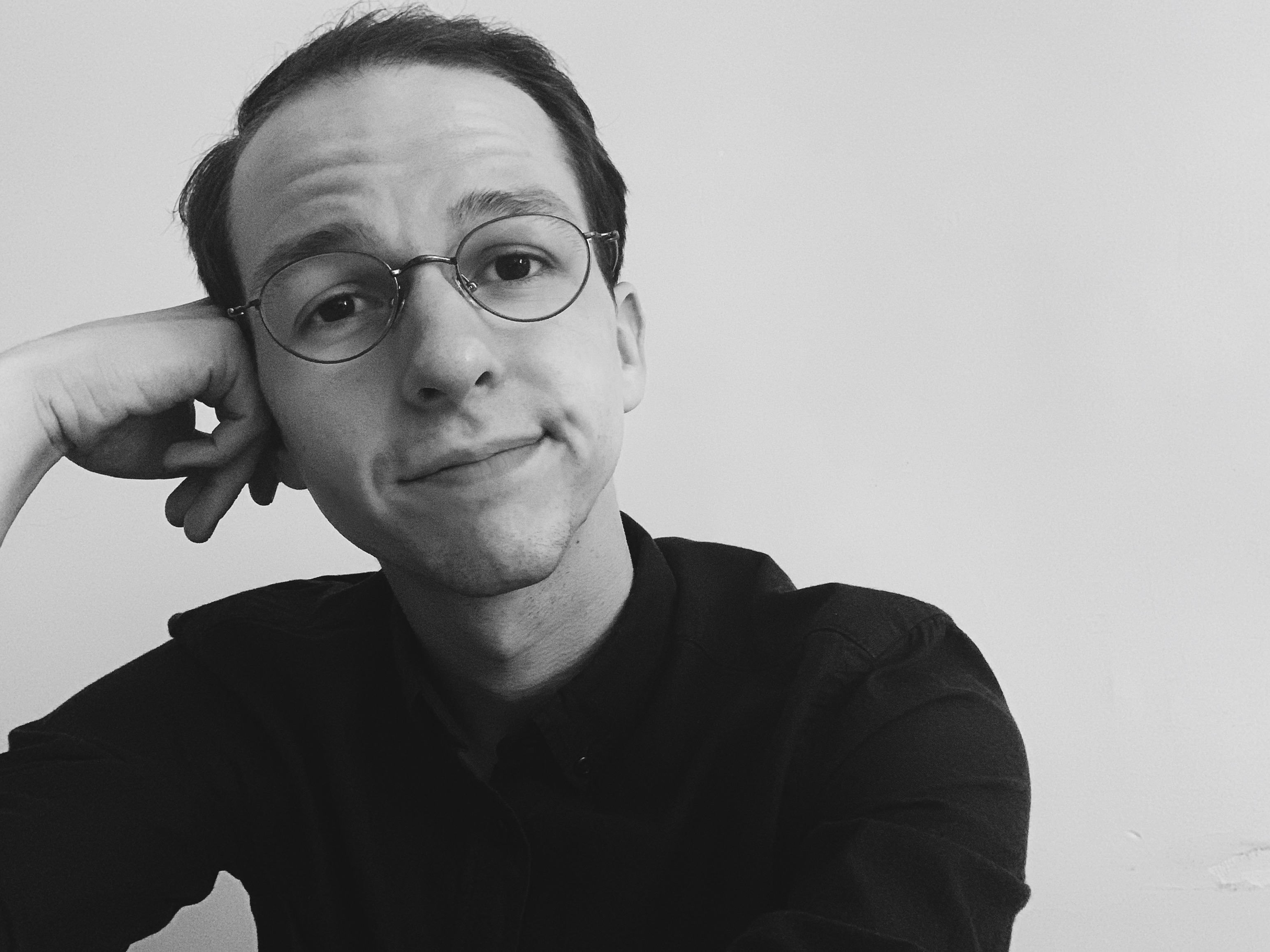
Michael Genese. Photo: Nikita Smirnov.

Sputter Box’s debut album, Sputter (SHRINKS THE) Box, features more than 25 brand new miniatures, each scored for bass clarinet, voice, and djembe.

The way we look” is Track 05 on the album.

NATASHA NELSON: Would you begin by talking a bit about your composition for Sputter Box? Was this the first time writing for the ensembleโ€™s instrumentation?

MICHAEL GENESE: Absolutely. This is the first time Iโ€™ve written for Sputter Box. The piece is called โ€œThe way we look.โ€ I wanted to find a piece of poetry that would say a lot with a little bit of text, since the pieces were supposed to be a minute or less. I wanted something that was short, but still said something worth saying.

I chose this excerpt from a poem by Richard Siken about the way we look at people: the way we interpret how someone looks, and how our looking at them might influence how they look.

It was really wonderful to write for Sputter Box. Itโ€™s an instrumentation that can be really sort of barren in a way: thereโ€™s no keyboard instrument, itโ€™s all very exposed, and as a string player-slash-vocalist, itโ€™s almost hard to latch onto some of the texturesโ€”but itโ€™s so unique and wonderful. Theyโ€™re such a great group.

Does โ€œThe way we lookโ€ include extended techniques?

MG: Yes, there are a few. The clarinet gets most of them. There are some key clicks, air sounds, and some timbral trills, for which Kathryn basically has to play the same note two different ways and toggle back and forth between them.

Were any aspects of the compositional process for this piece, and in writing for this instrumentationโ€™s particular timbral combination, surprising or unexpected?

MG: Getting the instruments to interact with each other in a way that was genuine and organic โ€“ especially writing for a group thatโ€™s [collaborating remotely], with three instruments that are so different timbrally โ€“ I thought the standard formula for writing music and counterpoint would get me farther than it did. I really had to be very mindful of how these lines could interact with each other, and how they could interact with each other specifically when the three of them werenโ€™t together in the same room.

I listened to a couple recordings on your website. I loved what I heard! One of the pieces I listened to was Bird Mansion, as well as Je me suis embarquรฉeโ€”I was really interested to see that title because I know the art song setting by Faurรฉ and itโ€™s a personal favorite. Would you like to discuss either of those pieces?

MG: Yeah, itโ€™s funnyโ€”actually, this morning I was working on Bird Mansion. Iโ€™ve been taking this mixing and mastering class, and Iโ€™m revisiting the mixes on my [recorded works]. Bird Mansion has actually been the trickiest, given the thick electronics part, and mastering every single source and component in the piece.

Listen to Bird Mansion, performed by JACK Quartet.

Bird Mansion was about the last apartment I had before I moved to New York. What I really like to do with my electronics pieces is preserve sound space, including things that we might take for granted. For example: the birds that live near the apartment weโ€™re at that might actually not be anywhere near where we go afterwards, the way the microwave sounded while it was runningโ€”those kinds of really small things that paint an aural picture of a place.

I loved that apartment so much and I was so excited to come here [to New York], but I didnโ€™t want to forget how the place sounded. Thatโ€™s still one of my favorite pieces that Iโ€™ve written. Itโ€™s really near and dear to me. Iโ€™m so glad you listened!

Would you also discuss Voices 21C? Did you co-found the organization?

MG: I am what we call a founding member. We started up in 2016. We were sort of birthed as this choir that was supposed to take part in a project that our conductor had, and none of us wanted to disband, so the people that founded it grew this non-profit organization. Weโ€™re Boston-based. A lot of our folks are from all over. Weโ€™re a social justice choir that uses our concert programs to tell narrative stories about current social justice issues. So we collaborate with a bunch of people, we work with childrenโ€™s choirs wherever we go, we perform at choral conferences, and discuss what choral music could be. Itโ€™s an organization on the front lines of questioning what choral music is and how it serves people.

Do you have any projects coming up that youโ€™d like to share?*

MG: Yes, letโ€™s seeโ€”next month [in June 2020] there is a digital music festival being hosted by ChamberQUEER. Iโ€™ve written a piece with a text by Phillip B. Williams for ChamberQUEER thatโ€™s premiering at some point this summer, which is really great. Thatโ€™s been a really exciting projectโ€”itโ€™s been really great to work with them.

*This interview took place on May 31. Genese’s composition What is meant, scored for soprano, baritone, and two violoncellos, premiered on June 24, 2020.
Listen to the recording here:


Listen to more music by Michael Genese at www.michaelgenese.com.

This article is part of a series, featuring interviews with 16 composers whose work is featured on Sputter Box’s debut album. Read the feature article here!

Interviews have been edited for length and clarity. #ShelterInSound