Q&A: Michael Genese

Composer Michael Genese discusses “The way we look,” featured on Sputter Box’s debut album.

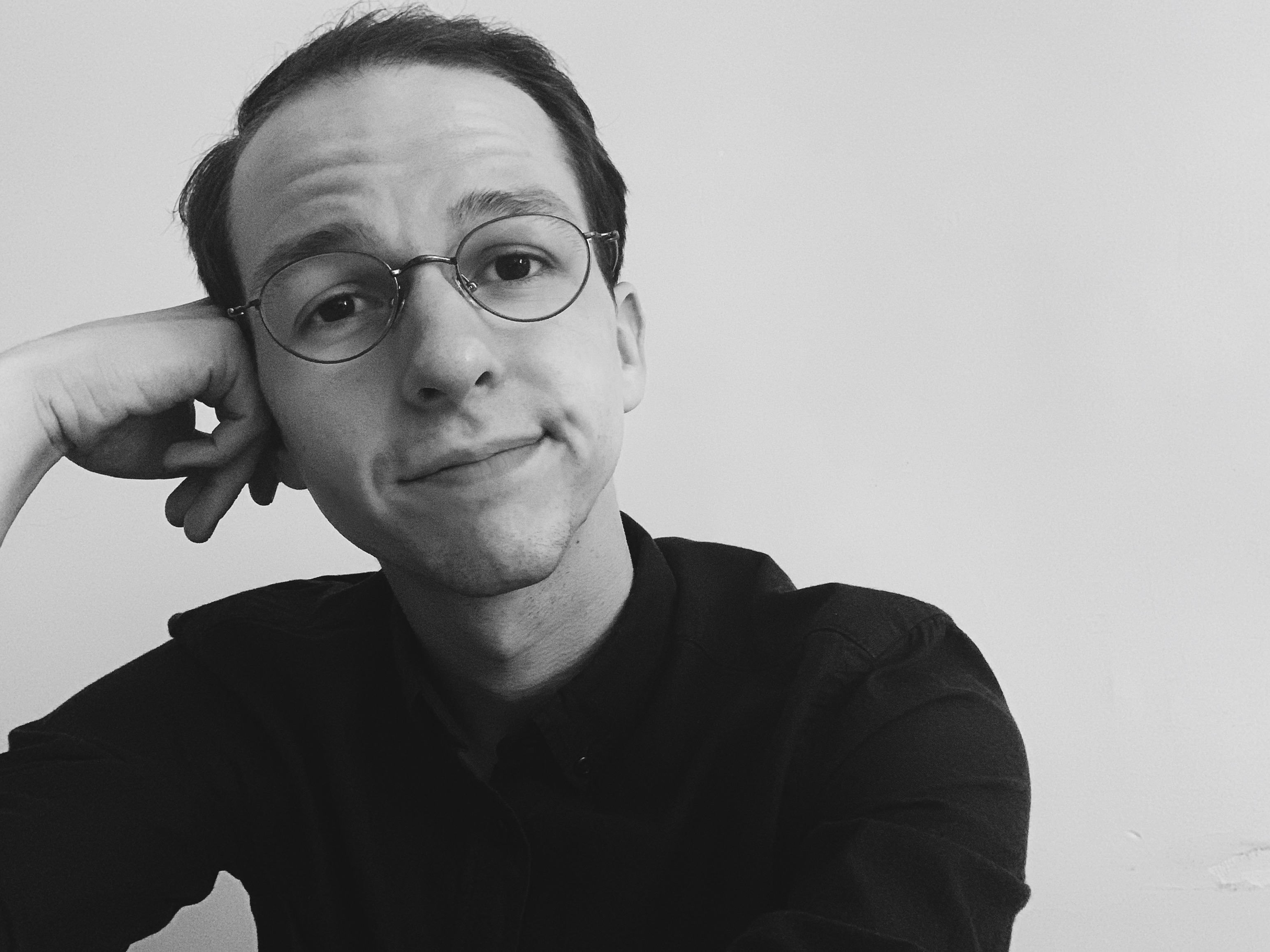
Michael Genese. Photo: Nikita Smirnov.

Sputter Box’s debut album, Sputter (SHRINKS THE) Box, features more than 25 brand new miniatures, each scored for bass clarinet, voice, and djembe.

The way we look” is Track 05 on the album.

NATASHA NELSON: Would you begin by talking a bit about your composition for Sputter Box? Was this the first time writing for the ensembleโ€™s instrumentation?

MICHAEL GENESE: Absolutely. This is the first time Iโ€™ve written for Sputter Box. The piece is called โ€œThe way we look.โ€ I wanted to find a piece of poetry that would say a lot with a little bit of text, since the pieces were supposed to be a minute or less. I wanted something that was short, but still said something worth saying.

I chose this excerpt from a poem by Richard Siken about the way we look at people: the way we interpret how someone looks, and how our looking at them might influence how they look.

It was really wonderful to write for Sputter Box. Itโ€™s an instrumentation that can be really sort of barren in a way: thereโ€™s no keyboard instrument, itโ€™s all very exposed, and as a string player-slash-vocalist, itโ€™s almost hard to latch onto some of the texturesโ€”but itโ€™s so unique and wonderful. Theyโ€™re such a great group.

Does โ€œThe way we lookโ€ include extended techniques?

MG: Yes, there are a few. The clarinet gets most of them. There are some key clicks, air sounds, and some timbral trills, for which Kathryn basically has to play the same note two different ways and toggle back and forth between them.

Were any aspects of the compositional process for this piece, and in writing for this instrumentationโ€™s particular timbral combination, surprising or unexpected?

MG: Getting the instruments to interact with each other in a way that was genuine and organic โ€“ especially writing for a group thatโ€™s [collaborating remotely], with three instruments that are so different timbrally โ€“ I thought the standard formula for writing music and counterpoint would get me farther than it did. I really had to be very mindful of how these lines could interact with each other, and how they could interact with each other specifically when the three of them werenโ€™t together in the same room.

I listened to a couple recordings on your website. I loved what I heard! One of the pieces I listened to was Bird Mansion, as well as Je me suis embarquรฉeโ€”I was really interested to see that title because I know the art song setting by Faurรฉ and itโ€™s a personal favorite. Would you like to discuss either of those pieces?

MG: Yeah, itโ€™s funnyโ€”actually, this morning I was working on Bird Mansion. Iโ€™ve been taking this mixing and mastering class, and Iโ€™m revisiting the mixes on my [recorded works]. Bird Mansion has actually been the trickiest, given the thick electronics part, and mastering every single source and component in the piece.

Listen to Bird Mansion, performed by JACK Quartet.

Bird Mansion was about the last apartment I had before I moved to New York. What I really like to do with my electronics pieces is preserve sound space, including things that we might take for granted. For example: the birds that live near the apartment weโ€™re at that might actually not be anywhere near where we go afterwards, the way the microwave sounded while it was runningโ€”those kinds of really small things that paint an aural picture of a place.

I loved that apartment so much and I was so excited to come here [to New York], but I didnโ€™t want to forget how the place sounded. Thatโ€™s still one of my favorite pieces that Iโ€™ve written. Itโ€™s really near and dear to me. Iโ€™m so glad you listened!

Would you also discuss Voices 21C? Did you co-found the organization?

MG: I am what we call a founding member. We started up in 2016. We were sort of birthed as this choir that was supposed to take part in a project that our conductor had, and none of us wanted to disband, so the people that founded it grew this non-profit organization. Weโ€™re Boston-based. A lot of our folks are from all over. Weโ€™re a social justice choir that uses our concert programs to tell narrative stories about current social justice issues. So we collaborate with a bunch of people, we work with childrenโ€™s choirs wherever we go, we perform at choral conferences, and discuss what choral music could be. Itโ€™s an organization on the front lines of questioning what choral music is and how it serves people.

Do you have any projects coming up that youโ€™d like to share?*

MG: Yes, letโ€™s seeโ€”next month [in June 2020] there is a digital music festival being hosted by ChamberQUEER. Iโ€™ve written a piece with a text by Phillip B. Williams for ChamberQUEER thatโ€™s premiering at some point this summer, which is really great. Thatโ€™s been a really exciting projectโ€”itโ€™s been really great to work with them.

*This interview took place on May 31. Genese’s composition What is meant, scored for soprano, baritone, and two violoncellos, premiered on June 24, 2020.
Listen to the recording here:


Listen to more music by Michael Genese at www.michaelgenese.com.

This article is part of a series, featuring interviews with 16 composers whose work is featured on Sputter Box’s debut album. Read the feature article here!

Interviews have been edited for length and clarity. #ShelterInSound

Q&A: Josh Trentadue

Composer Josh Trentadue discusses “ALL I WONDER,” featured on Sputter Box’s debut album.

Josh Trentadue. Photo: Brendan Prednis.

Sputter Box’s debut album, Sputter (SHRINKS THE) Box, features more than 25 brand new miniatures, each scored for bass clarinet, voice, and djembe.

ALL I WONDER” is Track 02 on the album.

NATASHA NELSON: Would you begin by discussing โ€œALL I WONDER,โ€ including your inspiration for the composition and its text setting?

JOSH TRENTADUE: Absolutely. I first heard about Sputter Boxโ€™s project Sputter (SHRINKS THE) Box when they started posting about it and started reaching out to composers asking them to write music for them. Iโ€™ve been a fan of the ensemble for quite some time now. What I really like about them is how much they have thought outside the box in terms of interdisciplinary approaches, in terms of chamber music, in terms of creating art for their instrumentation on top of that. I wanted to write something for them for this project that would reflect that, even though given the circumstances of the COVID-19 pandemic, that the approach to it was going to be different.

My inspiration for writing this really came as a spark. I woke up one morning and discovered that where I was living, it was pretty stormy outside and the weather was actually pretty bad. There was rain, there was a little bit of thunder and lightning, and just from that visual imagery alone that morning, the text basically wrote itself. I thought about all of the people who throughout this quarantine had been isolated, had been on their own through this pandemic living by themselves, and I thought about how each of us were all going through this in our own way, really. My approach to writing this was to write something that reflected that with the visual imagery of this weather, essentially, but leaving it open-ended with a question: to ask if there was the possibility that there was anyone else out there that was going through this, as well, who could relate to those circumstances.

What came first, the text or the melodic line?

JT: For me, the text came first: that visual imagery of the weather outside that one day gave me the idea for it. I wrote it all down, then did a little editing afterwards. What I tried to do with the music was find a way to be able to reflect that, as well.

Did the contour of the vocal line, specifically, come from imagery in the text or from the rhythm of the words in a very particular way?

JT: Yesโ€”the rhythm of the words, definitely. I tried to write something that was going to fall in line with that, but I also wanted to write something with the contour that was going to add to the emotional despair of the piece. Something that was going to add to the loneliness, or that fear of being lonely.

Does โ€œALL I WONDERโ€ include extended techniques?

JT: Yes, there are quite a few, mostly for bass clarinet and djembe. I asked Peter to play a couple of slaps on the djembe which create more of a punctual sound, as opposed to just playing the drum on its own. I also asked him to use a couple of techniques where itโ€™s his fingers only, so that you get more of the overtones of the drum. He also made them really quiet, too. My idea for that was to create some texture that was going to add to the visual imagery of this weather that I described. And for Kathryn, for bass clarinet, I asked for similar things, too, to add to that imagery. For example, there are a couple places where sheโ€™s asked to blow air through her instrument at no pitch whatsoever; itโ€™s just air, and with that I wanted to create the idea of this wind blowing through the storm.

Would you explain the effect of a timbral trill, written here in the score for bass clarinet?

JT: Sure. A timbral trill is essentially when an instrumentalist is asked to do a trill on a singular note, but all that theyโ€™re changing is the fingering for that note. For this piece, specifically, I asked Kathryn to do a trill on the exact same note, but the fingerings on it are different; she has a fingering and an alternate fingering that she goes back and forth between. That creates โ€“ in my mind, at least โ€“ a different sound or texture than, say, if you were to trill between two different notes.

Shifting focus for a moment to the vocal part, Iโ€™m curious to hear about your choice for notating the last lines of the text โ€“ โ€œHear me? Hear me?โ€ โ€“ with x-noteheads in the score.

JT: For the text and with the repeat, I wanted to create an echo of the [penultimate] line, โ€œCan you hear me?โ€ With the notation, I asked Alina to not rely on pitch so much and lean more on a whisper, so that it can create for the listener this idea that there is an echo being lost in the wind.

I enjoy exploring the following question, as well, with regard to notation for text settings in vocal music: what idea inspired your choice to notate those final lines, indicated with x-noteheads, on that specific pitch (Eb4), versus elsewhere on the staff? Are the lines intended to be half-pitched in a way?

JT: I think the reason I chose this pitch was because I liked where it was in the register and I liked how it added to the rest of the other music going on. I think it gave more of a quality of a whisper or an echo for what I was looking for here, as opposed to higher in the range, or maybe even lower in the range.

Would you speak for a moment about M.O.T.I.F. (Music of the Introspective Fields)?

JT: So that is the name Iโ€™ve given for my self-published work, my self-publishing company. For me it means two things: the first being that music for me is always about introspection. Thatโ€™s where it starts: how we feel inwardly, and then translating that to how we express it outwardly. And the second part of it being that a motif is basically a little musical identity or fragment thatโ€™s constantly repeated or reworked or developed over time throughout a piece. And motives are something that I continue to work with in my own music.

Is there anything more youโ€™d like to share about this piece or this project?

JT: I think that about covers the piece in particular and the ideas that I had behind it, but I would like to mention, as well, that Iโ€™m very, very grateful to Kathyrn, Alina, and Peter for this opportunity to be able to keep creating music, especially with other people during this crisis and during this time that a lot of artists are really struggling right now.


Trentadue is co-founder of the Milennium Composers Initiative (MCI).
Listen to more on SoundCloud.

This article is part of a series, featuring interviews with 16 composers whose work is featured on Sputter Box’s debut album. Read the feature article here!

Interviews have been edited for length and clarity. #ShelterInSound

Q&A: Daijana Wallace

Composer Daijana Wallace discusses “Through Distance,” featured on Sputter Box’s debut album.

Daijana Wallace. Photo: Julian Kincaid.

Sputter Box’s debut album, Sputter (SHRINKS THE) Box, features more than 25 brand new miniatures, each scored for bass clarinet, voice, and djembe.

Through Distance” is Track 01 on the album.

NATASHA NELSON: Would you begin by talking a bit about your piece โ€œThrough Distanceโ€?

DAIJANA WALLACE: I think I pride myself on being able to write for my friends, and so this project was really intuitive to come by. I knew Kathryn before โ€“ I had met her at Cortona Sessions in 2018 โ€“ and Iโ€™ve been following her work through this ensemble. I loved the work of Sputter Box, but we hadnโ€™t previously been able to line anything up because of our various schedules.

I think in general, writing during the quarantine was very, very difficult. I was thinking about all the various projects popping up about collaborating via Zoom or Skype, but there were so many. It was nice to get to write something for friends in a project that I felt good about, amongst all the other ones to possibly choose from.

Are the Cortona Sessions geared toward contemporary classical performance?

DW: Yes. Itโ€™s Cortona Sessions for New Music, and what itโ€™s about is giving composers and performers opportunities to work together, and to get mentored by composers and performers who perform a lot in that medium. For composers, itโ€™s a chance to learn how to work with new people in a short amount of time. The first year I was there auditing, which was great. I observed a lot and learned so much. I attended again the next year and participated as a composer.

Listen to Daijana Wallaceโ€™s piece “Upstairs Neighbor,” written for the Cortona Sessions for New Music in 2019. Performed by Kivie Cahn-Lipman (cello) and Eli Geruschat (percussion).

Whatโ€™s your primary instrument?

DW: My primary instrument is cello.

What kinds of pieces do you often focus on writing, and for what instrumentation? Was this composition particularly new in any way?

DW: Not necessarily. Iโ€™ve written a lot of chamber works, which make up most of my catalogue, and Iโ€™ve written for voice before, but every voice is so different: yes, you have rangeโ€”but whatโ€™s the sound? The singerโ€™s tone? How does their voice operate? Thatโ€™s always a challenge, but I just tried to keep it safe [laughs]. Iโ€™ve written for percussion in solo and chamber settings and for wind instruments, as well. I hadnโ€™t written for clarinet yet, specifically, so it was great.

“Shades,” for solo cello. Composed by Daijana Wallace; performed by Kivie Cahn-Lipman.

What was it like composing a minute-long piece? As a composer, how does one go about writing material to fit a specified duration?

DW: I think this is particularly difficult, because I like to think that I write short piecesโ€”and when I say short pieces, I mean pieces that are about less than ten minutes long. So this was challenging to write something for just one minute. How much detail do you have to put in? Do you want it to be like a tiny rhapsody? Do you want it to have an A-B structure? The thought of form comes to mind, as well as musical complexity.

Not only is quantity of material a factor, but how much time does an ensemble have to rehearse it and put it together? For this project, Sputter Box asked that scores didnโ€™t have a lot of syncopation and a lot of improv because of the medium that they were working with. I especially love adding improvisation elements in my scores, so the challenge there was to get away from that a bit. Iโ€™ve always wanted to try out songwriting, so I feel like this was a really fun moment for me.

Hear Wallaceโ€™s improvisatory piece entitled “Spaces,” featuring performers Justin Noel Hall (percussion), Chris Agnew (alto saxophone), and Genevieve Rucker (horn).

Had you heard Sputter Boxโ€™s vocalist, Alina Tamborini, sing prior to writing this piece?

DW: Yes, Sputter Box posts various videos on Instagram and Twitter.

Right! I seem to have forgotten about the presence of the internet for a moment there.

DW: [laughs] I had listened to most of the โ€œSputter (SHIFTS THE) Boxโ€ miniatures before I had even decided to start the project, just to see what everybody else was writing, as well as what everyone else was doing for these wonderful musicians. So I had done a little bit of research, but itโ€™s so different when youโ€™re doing everything virtually, without getting to interact with a collaborator in person.

Would you describe the text for โ€œThrough Distanceโ€?

DW: Since weโ€™re talking often about social-distancing, I wanted to think about the idea of distance, but not in the way that everybody was thinking about it in the current moment. The easiest thing to draw inspiration from was being in a [long-distance] relationship with my boyfriend, and thinking about that in retrospect, since weโ€™re spending a lot of time together now. The text addresses distance, but not the distance that weโ€™re all facing right now.

For other vocal compositions youโ€™ve written, did you set your own texts for those, as well?

DW: Iโ€™ve worked with a poet named Julien Evans. I set their text for a song for string quartet and voice. Julienโ€™s poetry really spoke to me in this way that they write. Itโ€™s almost difficult to want to be writing my own text โ€“ and think about writing my own text โ€“ when they just produce such amazing, wonderful work. But for a project like this, itโ€™s so short and so small, you know? Usually poems take up a lot of time, spatially.

How so?

DW: When I think of text-setting for art songs, even if theyโ€™re short art songs, they range from about two minutes, onward. Working with text like that, you really want to dedicate a lot of time and energy into it. For this project, it was easier to write my own. For other projects, Iโ€™m definitely looking for texts from other poets, or from snippets of Tweets, or something I see on the internet.

When writing โ€œThrough Distance,โ€ what part of the texture came first: the text and vocal melody, or the bass clarinet and percussion parts?

DW: I sang through the vocal line multiple times to figure out how the text was going to flow, and how it was going to sound, so that came first for sure. What came next, [through] singing it over again, was how to evoke this R&B vibe, given the instruments that were available for me to write for.

What elements did you write into the score to evoke that in particular?

DW: Thatโ€™s a great question, thanksโ€”I think itโ€™s the constant pulse with Peter in the percussion. When I think about music, itโ€™s always through โ€“ thereโ€™s always this thing about โ€“ feeling. The way that I felt this R&B Ballad could come together was [demonstrates rhythmic figure] and also, the sound of it. I wanted to make sure that it sounded good, to also supplement that feeling.

Would you describe your approach to crafting the vocal melody within the instrumental texture created by the clarinet and percussion parts in the score?

DW: When I was constructing this piece, the vocal part came first and the percussion part came after that to establish this rhythm, this groove. Then, the clarinet came in to reinforce harmony and add background textures. That was the last part in the composition process.

I think the voice and percussion are at the forefront of this workโ€”and it makes sense. Itโ€™s like a pop song, almost, just for instruments. That was the order of operations: the vocal line, then percussion, and then the clarinet to add harmony, as well as texture.

Does the composition include extended techniques?

DW: I think the only thing that I have in there are some wind noises for bass clarinet, but nothing super crazy [laughs].

Did writing for a digital medium, versus for live performance, influence your compositional approach to the piece? Were there any surprising elements in hearing the finished recording for the first time?

DW: Yes. I think what I was surprised about was to hear it all come together. Iโ€™m not sure what editing software the ensemble used, but everything sounded like one collective unit. And even though I had heard the other videos before, and they sounded great, [itโ€™s unique] when itโ€™s your project and itโ€™s your baby.

Would you like โ€œThrough Distanceโ€ to be performed live once we have access to concert halls again, or is the compositionโ€™s creation for a digital medium, specifically, essential to the work?

DW: Itโ€™s so different to think about pieces being performed โ€“ and written to be performed โ€“ in a virtual medium, as opposed to pieces being written to be performed in a physical medium. I think that if this were to be possible in a physical medium, I would love to expand more on it if given the time, because itโ€™s just one-minute long. If it were expanded into a collection of miniatures or into a full song, I feel like for me, it would be more fulfilling in a physical medium. But I wouldnโ€™t be opposed to having more interpretations of this virtually. I think that would be really awesome.

Is there anything youโ€™d like to add that we havenโ€™t talked about today?

DW: Iโ€™m really appreciative that I got this chance to work with such incredibly talented and dedicated musicians. Thatโ€™s one thing I love about composing: I have one part, but the performers make everything about composing possible. I just have to thank them one more time.


Find Daijana Wallace’s website at daijanawallace.com.

This article is part of a series, featuring interviews with 16 composers whose work is featured on Sputter Box’s debut album. Read the feature article here!

Interviews have been edited for length and clarity. #ShelterInSound